
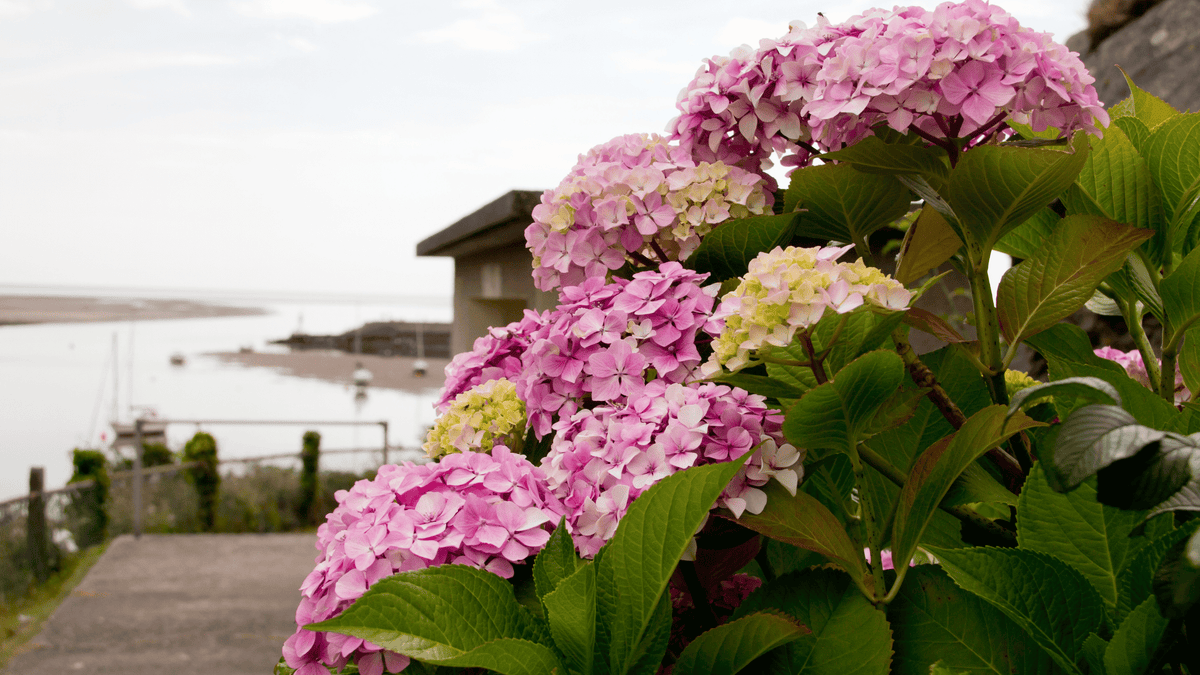
Hydrangeas can be excellent shrubs for a coastal garden, but success depends on separating two conditions that are often treated as though they were the same. Salt-laden maritime air is tolerated surprisingly well by some hydrangeas, particularly Hydrangea macrophylla, whereas persistent drying wind can damage foliage, increase moisture loss and leave an otherwise healthy shrub looking battered. In an exposed Irish garden, the better approach is usually to choose a suitable hydrangea and then give it some protection rather than planting it on the most wind-swept boundary.
This distinction matters because a hydrangea growing near the sea may cope perfectly well with maritime conditions when sheltered by a wall, fence or existing planting, yet struggle a short distance away in an open position. The broader principles of soil, moisture and care are covered in our guide to growing hydrangeas in Ireland; here the emphasis is specifically on coastal exposure and wind.
Can hydrangeas grow in coastal gardens?
Yes. Hydrangea macrophylla is particularly noteworthy because it can tolerate maritime conditions and aerial salts better than its lush foliage might suggest. Established plants have been recorded thriving in coastal sites exposed to sea breezes, and some cultivars have long been recommended specifically for seaside gardens. Coastal conditions can also allow these hydrangeas to tolerate more direct sun than they would comfortably accept in a hotter, drier inland climate.
That does not make every seaside position suitable. Hydrangeas still prefer a fertile soil with reliable moisture and good drainage, and the combination of poor ground, drying wind and strong sun can place considerable strain on the plant. A coastal garden with reasonable soil and some shelter is therefore very different from a bare, exposed site where the shrub receives the full force of the wind.
Hydrangeas that are particularly useful near the coast
Hydrangea macrophylla ‘Lanarth White’
Hydrangea macrophylla ‘Lanarth White’ is one of the more convincing choices for a maritime garden because it has a documented reputation for coastal tolerance. Its white lacecap flowers also make it useful where the rounded bulk of a traditional mophead would feel too heavy. It has been noted for its ability to grow in full sun near the coast, although that should not be interpreted as a reason to put it in a dry, wind-scoured position. Consistent moisture remains important.
Hydrangea macrophylla ‘Ayesha’ and ‘Blue Wave’
Several established H. macrophylla cultivars appear in recommendations for seaside planting, including Hydrangea macrophylla ‘Ayesha’ and Hydrangea macrophylla ‘Blue Wave’. Their value is not that they become windproof shrubs, but that the species is unusually comfortable with maritime air when its other requirements are met. They are therefore better considered for a sheltered coastal border than used as the first line of defence against an exposed Atlantic wind.
Hydrangea arborescens ‘Annabelle’
Hydrangea arborescens ‘Annabelle’ is another source-supported option for salt-air conditions, provided the soil retains sufficient moisture without becoming badly drained. There is, however, a practical qualification in a windy garden. Its large flower heads can become heavy, and the stems are not always as rigid as those of more upright shrubs, so ‘Annabelle’ is much more satisfactory behind some protection than in a position where every flowering stem is being pushed about by strong wind.
Oakleaf and panicle hydrangeas
Oakleaf hydrangeas, Hydrangea quercifolia, have also been recommended for seaside planting and are worth considering where their larger mature size suits the border. Their coarse, oak-shaped foliage and autumn colouring give them a different character from the familiar mophead hydrangeas. The old-fashioned panicle hydrangea Hydrangea paniculata ‘Grandiflora’, often called PeeGee, is another recorded coastal choice, although neither group should be treated as indifferent to persistent wind.
Where the purpose is primarily plant selection, the wider Hydrangea collection provides the useful commercial overview, while the choice for a difficult coastal site should still be narrowed according to exposure, available shelter and soil moisture.
Why wind is often the greater problem
Hydrangea foliage is relatively broad and soft, so strong moving air can cause both physical damage and rapid moisture loss. Early foliage may become torn or tattered in an exposed position, while the root zone can dry more quickly than the appearance of a damp maritime climate might suggest. A shrub may survive these conditions without ever looking particularly good, which is an important difference when the plant is being grown for large, immaculate leaves and flowers.
For that reason, shelter is more useful than searching for a supposedly indestructible hydrangea. Fences, evergreen shrubs and other established planting can reduce the force of the wind, and a protected position beside a building can also be effective. The objective is not complete stillness. It is simply to prevent the hydrangea from receiving the strongest wind continuously.
On a genuinely exposed boundary, a hydrangea is usually better placed behind the protective planting rather than expected to form the windbreak itself. Laurel's plants for windy and exposed gardens can be useful where a tougher first layer is needed before more moisture-loving shrubs are introduced.
Plant for moisture as well as shelter
Wind protection alone will not compensate for poor establishment. Hydrangeas perform best in soil enriched with organic matter, with enough moisture retention to prevent repeated drying but sufficient drainage to avoid a stagnant root zone. Incorporating well-rotted organic material before planting and applying a generous mulch afterwards are particularly useful where coastal soils are light or quick to dry.
New plants need closer attention than established shrubs because their roots have not yet spread into the surrounding ground. Water thoroughly after planting and continue to monitor the root zone during dry or windy weather. A thick mulch reduces evaporation and gradually improves the soil, but it should not be used as a substitute for watering when the ground beneath has already become dry.
Spacing also deserves attention. Crowding several hydrangeas tightly against a shelter may reduce wind, but it creates competition for water as the shrubs mature. Allowing each plant sufficient room for its eventual spread produces a stronger plant and avoids severe pruning later. The practical process is covered more fully in our guide to planting hydrangeas and establishing them successfully.
How much sun should a coastal hydrangea receive?
Coastal conditions alter the usual relationship between hydrangeas and sunlight. Hydrangea macrophylla can perform well in considerable sun in cool maritime locations, and established plants are known from exposed coastal gardens where the same amount of sun would be harder on them in a hot, dry climate. Reliable soil moisture is part of the reason this works.
Wind changes the calculation. A position that combines strong sun with constant wind encourages faster water loss and can leave foliage scorched or ragged, so shelter should take precedence over an attempt to maximise sunlight. A bright position with some protection is often preferable to an open south-facing site simply because it receives more sun. Where the available shelter creates substantial shade, the separate guide to hydrangeas in shade explains which types cope best with lower light.
Choosing the best position in an exposed garden
The most successful coastal position is usually one that moderates exposure without depriving the shrub of light, moisture or growing space. A hydrangea may sit comfortably inside a garden that feels quite windy overall if a fence, hedge or group of evergreen shrubs breaks the strongest airflow before it reaches the plant. Conversely, a sheltered-looking corner can still be difficult if the soil is shallow and dries rapidly.
- Keep hydrangeas away from the most wind-swept, full-sun part of the garden where a more tolerant shrub would be better suited.
- Use existing fences, evergreen planting or other structures to reduce the force of persistent wind.
- Prepare the soil for moisture retention while maintaining good drainage, and mulch after planting.
- Give newly planted hydrangeas reliable water until the roots have established beyond the original root ball.
- Allow enough space for the mature shrub rather than crowding it tightly into the only sheltered corner.
Where salt-laden air is the main challenge and reasonable shelter already exists, hydrangeas can be remarkably successful and H. macrophylla deserves particular consideration. Where the garden is both coastal and severely wind-exposed, the priority changes: create protection first, establish the soil and then place the hydrangea within the improved microclimate. For broader planting around such sites, Laurel's plants for coastal gardens provide suitable options for building a more resilient planting scheme around the hydrangeas.


