
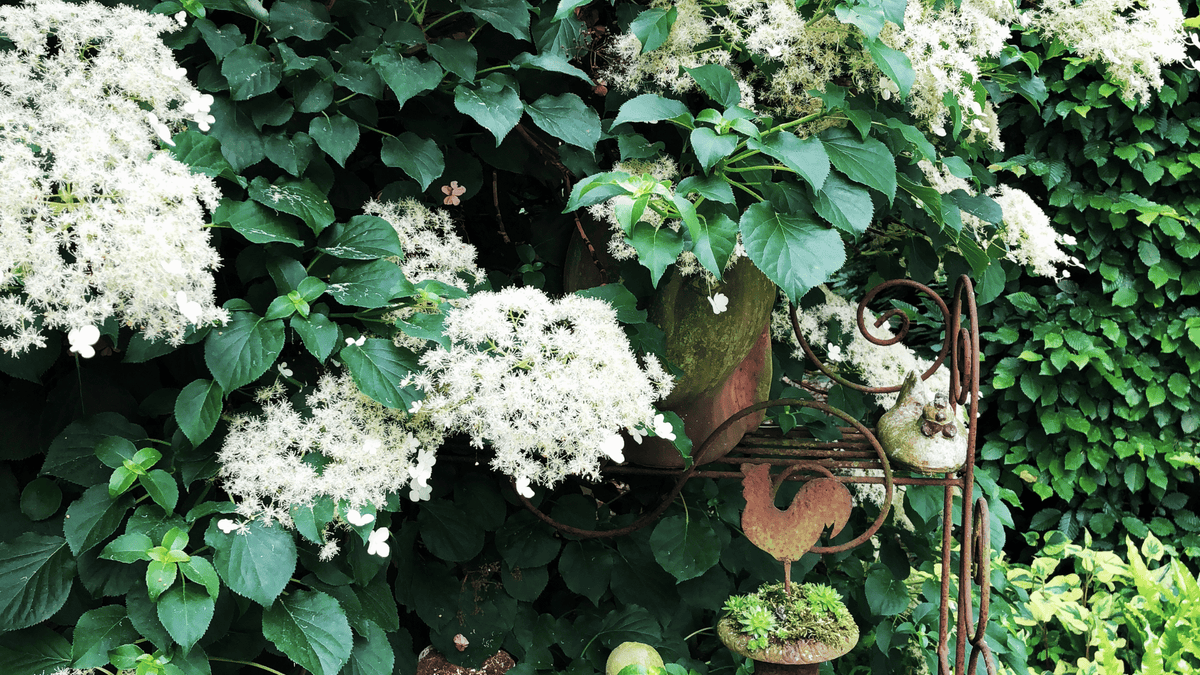
Climbing hydrangea, Hydrangea anomala subsp. petiolaris, requires rather different planning from the familiar mophead, lacecap and panicle shrubs. It is a large woody climber that attaches itself directly to a suitable surface, grows well in shade and can eventually cover a substantial wall or mature tree. The difficulty is rarely controlling it while young. It is allowing enough room for what a well-established plant can become.
Position and support therefore matter more than frequent feeding or complicated maintenance. A young plant may make surprisingly little visible progress while it establishes, then grow much more strongly once settled. The broader principles of growing hydrangeas in Ireland still apply, but climbing hydrangeas have a growth habit, mature scale and flowering pattern that deserve to be considered separately.
What makes a climbing hydrangea different?
Rather than twining around wires or needing its stems tied permanently to a framework, climbing hydrangea produces rootlike holdfasts along its stems. These attach to bark, timber, brick and other suitable surfaces, allowing the plant to form a close-fitting woody framework. In its younger phase the stems tend to remain quite flat against the support; with maturity, secondary branches begin to project away from that framework and the plant develops considerably more depth.
Those secondary branches are important because they also carry much of the floral display. Established plants produce broad white lacecap-like flower heads in early summer, while older stems develop attractive peeling brown bark. The result is not simply a flowering climber but a substantial architectural plant, quite distinct from the shrub forms covered in our guide to the different types of hydrangeas.
Where do climbing hydrangeas grow best?
Shade tolerance is one of the great strengths of Hydrangea anomala subsp. petiolaris. It is well suited to north- and east-facing structures and can also grow beneath the canopy of deciduous trees, making it especially useful where a large flowering climber is wanted without a sunny wall. Full sun is possible too, provided the roots have sufficient moisture, so shade should be regarded as an opportunity rather than an absolute requirement.
The soil need not be unusually specialised. Good drainage matters, however, and young plants perform better where moisture remains reasonably even rather than alternating between prolonged wetness and drought. Where the principal problem is low light rather than climbing habit, our guide to growing hydrangeas in shade explains the wider relationship between light, moisture and flowering.
A north-facing wall can therefore be an excellent long-term position, particularly where many other flowering climbers would be less comfortable. The amount of usable light still varies considerably from one site to another, so a wall open to the sky should not be treated in the same way as a dark enclosed passage. The same distinction is useful when planning a north-facing garden around the climber.
Plan for the mature plant before planting
Climbing hydrangeas are slow enough when young to disguise how large they can eventually become. Around 12 metres is a realistic scale for an old specimen in favourable conditions, while particularly established plants can become larger still. This growth develops over many years, but the eventual size should influence the choice of position from the beginning.
A substantial house wall, large outbuilding or mature tree can absorb that scale gracefully. A small lightweight screen cannot. The support also influences the way the plant develops: on a relatively low structure it reaches the limit of its upward growth sooner and begins forming more lateral branches, whereas a plant on a very tall tree may continue climbing for much longer before producing its strongest floral display.
Planting and establishing a climbing hydrangea
One of the most useful things to understand is that slow early growth is normal. During its first years the plant is establishing the root system and permanent framework on which later vigour depends, so an apparently healthy plant that has made little height is not necessarily struggling. Repeated feeding in an attempt to force rapid top growth is unnecessary; modest feeding and steady moisture are more appropriate while the plant establishes.
Plant into soil that drains freely and water thoroughly during dry periods while the roots are young. A mulch of compost or other suitable organic material can help conserve soil moisture, particularly where the surrounding ground dries quickly. Once established, climbing hydrangea becomes considerably more self-sufficient, which is one reason an old specimen can be remarkably undemanding despite its eventual size.
Growing a climbing hydrangea on a wall
Brick, stone and other textured surfaces suit the plant because its holdfasts can make direct contact with them. This attachment should be regarded as permanent rather than temporary. Older stems can cling very firmly, and removing them later may leave attachment marks or residue on the surface, so climbing hydrangea is better on a wall that can remain clothed for many years than on one that requires frequent repainting or alteration.
The same permanence makes it effective on a large blank elevation. The close-fitting young stems gradually develop projecting flowering branches, creating depth without requiring a conventional trellis over the entire wall. Growth around windows, doors, gutters or other areas that must remain clear should be watched before heavy woody stems occupy them, since modest regular restraint is easier than major correction after many years.
Growing a climbing hydrangea on a fence or trellis
A fence can work very well, but it needs to be substantial. Mature climbing hydrangeas develop a considerable framework of woody stems and side branches, so a strong permanent fence or robust trellis is a more sensible partner than a lightweight decorative panel. The plant itself may take years to become heavy, but choosing the support for the eventual specimen avoids an awkward rebuilding job later.
A lower fence also changes the character of the plant. Once the main stems can climb no further, growth is more likely to spread laterally and develop the secondary branches associated with flowering. This is why a climbing hydrangea on a modest structure may produce an obvious floral display sooner than the same plant set at the foot of a very tall tree.
Growing a climbing hydrangea up a tree
A mature tree with a substantial, rough-textured trunk makes one of the most natural supports. The climbing stems can attach directly to the bark and eventually clothe much of the trunk with green foliage and white flowers, producing an effect quite different from a conventional climber trained against a garden structure.
Scale matters here as much as anywhere. Given a very tall tree, climbing hydrangea is capable of continuing upwards for many years, and much of the eventual flowering growth may be well above eye level. Where flowers are the main objective, a shorter wall or structure usually gives a more intimate result; where the intention is to create a large woodland feature, the height of a mature tree can be an advantage.
Why can climbing hydrangeas take years to flower?
Delayed flowering is closely connected with the way the plant matures. Early growth is largely concerned with establishing roots and extending the main clinging stems. As the permanent framework develops, more horizontal and projecting secondary branches are formed, and these are the branches that carry the stronger floral display. A healthy young climber may therefore be doing exactly what it should even though flowers remain sparse.
The height of the support can extend that juvenile-looking phase. A plant that reaches the top of a lower structure relatively quickly can devote more growth to lateral branching, while one still ascending a tall trunk has much farther to travel. Heavy feeding does not remove this basic developmental pattern. Time, a suitable site and an appropriately scaled support are generally more useful than trying to force the plant into premature flowering.
How to prune a climbing hydrangea
Established climbing hydrangeas need very little routine pruning. The usual reasons for cutting are practical ones: keeping growth away from a window or doorway, preventing side branches from narrowing a path, removing damaged wood or stopping the plant from extending into an area where it is not wanted. A well-positioned specimen should not need repeated hard reduction simply to make it fit.
The flowers arise from older wood, so severe pruning can also remove productive flowering growth. This makes gradual control preferable where possible. The best long-term approach is to give the plant enough room from the outset, then intervene selectively as its framework develops rather than allowing it to exceed the available space and attempting a major renovation afterwards.
Choosing a climbing hydrangea
The species itself is the important starting point because its shade tolerance, attachment method and mature habit define how it should be used. A named form such as Hydrangea anomala subsp. petiolaris ‘Miranda’ is still a substantial climbing hydrangea, so the same considerations about patient establishment, permanent support and mature scale apply when deciding where to plant it.
For gardeners comparing options for a wall, fence or mature tree, Laurel's climbing hydrangeas provide the most relevant group to browse. The most successful choice is not simply the climber that looks manageable in its nursery pot, but the one whose eventual structure belongs naturally on the support available. Given that space, climbing hydrangea develops slowly into a large, long-lived feature that can bring flowers and foliage into parts of the garden where many showier climbers are less convincing.


