
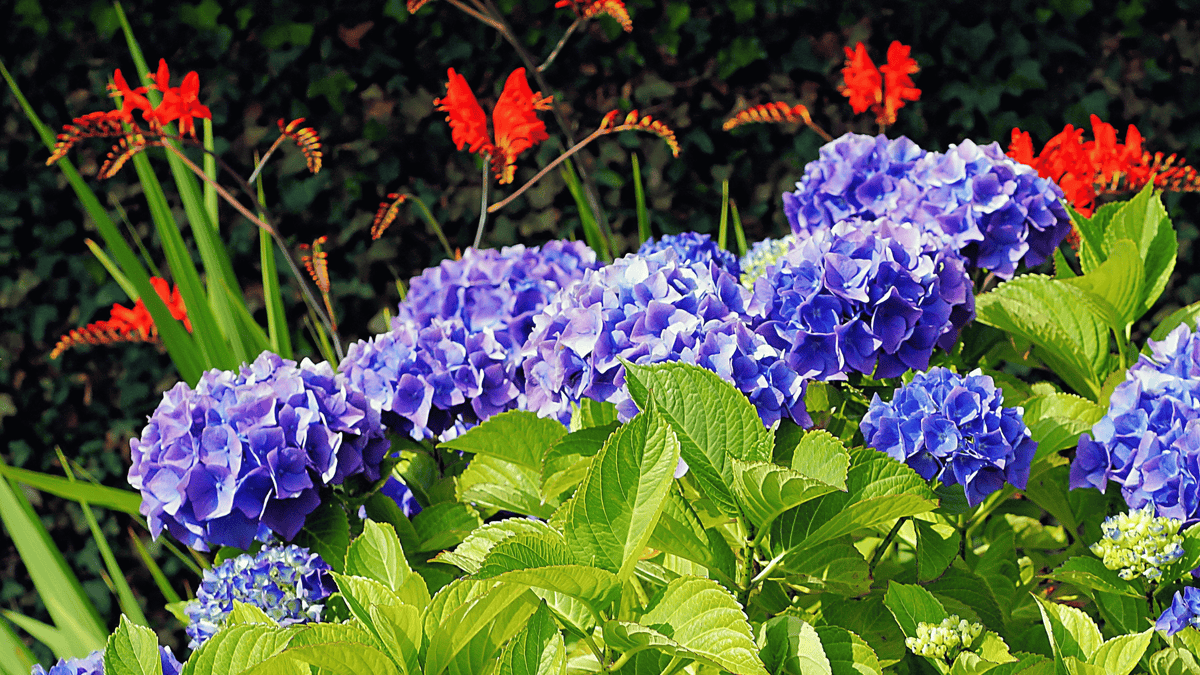
A good companion plant for a hydrangea has to do more than look attractive beside it. The two plants must first be comfortable in the same light, soil and moisture conditions; after that, colour, foliage, flower shape and scale determine whether the combination becomes a coherent planting or merely a collection of individually attractive plants.
This matters particularly with hydrangeas because the genus is varied. A shaded border built around a broad-leaved Hydrangea macrophylla needs different companions from a sunny planting centred on Hydrangea paniculata. The broader differences between the groups are covered in our guide to growing hydrangeas in Ireland, while the Hydrangea collection provides a useful starting point when the main shrub has not yet been chosen.
Choose companions for the hydrangea and the site
The hydrangea should normally be chosen first, because it establishes the scale and growing conditions around which the rest of the planting must work. Mopheads and lacecaps are especially useful in moist, partly shaded borders, whereas panicle hydrangeas are better adapted to brighter positions. Smooth hydrangeas sit comfortably in mixed and more naturalistic planting, provided moisture and drainage are suitable.
Hydrangea arborescens ‘Annabelle’ is a useful example of a shrub that can be woven through a mixed border rather than treated as an isolated specimen. Its substantial white flower heads are visually strong, but the neutral colour allows neighbouring foliage and flowers to carry more colour without the planting becoming confused. Hydrangea paniculata ‘Limelight’, by contrast, represents the sunnier panicle group, where daylilies and other summer perennials become much more practical companions.
Where light is limited, the choice should be narrowed before thinking about colour. The guide to hydrangeas in shade deals with those distinctions in more detail. Mature spread matters just as much, particularly in restricted borders, and a companion planting cannot rescue a hydrangea that is simply too large for the space; in that situation, start with the guide to compact hydrangeas for small gardens.
Build the planting around foliage first
Hydrangeas already provide a considerable mass of flower, so adding one showy flowering plant after another can make a border visually heavy. Foliage is usually the better starting point. Broad leaves can repeat the weight of the hydrangea and create continuity, while finely divided or narrow foliage provides contrast and prevents the planting from becoming a succession of similar rounded shapes.
Hostas are particularly effective beneath hydrangeas in shaded or lightly shaded borders. Hosta ‘Elegans’ has the large, blue-toned leaves that make this relationship especially convincing: its foliage is broad enough to hold its own beside a mature hydrangea, yet its low mound establishes a clear lower layer beneath the shrub. Other substantial choices can be found among large and giant Hostas. In a looser woodland-style scheme, ferns provide the opposite effect, their divided fronds introducing a much finer texture beside the solid leaves and flower heads.
Astilbes introduce another useful change of form. Their lighter, feathery flower panicles rise through a planting without competing directly with the rounded mass of a mophead hydrangea. Astilbe ‘Deutschland’ can be used in this role where the site provides the moist, partly shaded conditions that both plants favour. Repeating several Astilbes as a drift is usually more effective than scattering several unrelated perennials around a single hydrangea.
Closer to the front of the border, Alchemilla mollis is particularly useful with blue-flowered hydrangeas. Its softer mound and airy flowers form a low transition between the shrub and the border edge rather than creating another competing focal point. Ajuga can perform an even lower ground-covering role; Ajuga reptans ‘Best Buddies Caramel’ is one Laurel example that can occupy this layer without obscuring the base of the hydrangea.
Bolder foliage can also work when it is kept lower than the shrub. Bergenia cordifolia ‘Purpurea’ gives a broad-leaved ground layer with enough visual weight to sit beside a substantial hydrangea, while its evergreen foliage can continue to provide structure after deciduous hydrangeas have lost their leaves.
Use different companions around sunnier hydrangeas
The companion palette becomes wider when the hydrangea grows in a brighter border. Daylilies are a classic example because their narrow, strap-like foliage contrasts strongly with the broad leaves of hydrangeas, while their flowers occupy a different shape and height. The combination is most convincing where both plants receive enough light, rather than trying to force a sun-loving daylily into a deeply shaded mophead planting.
Hemerocallis ‘Stella de Oro’ can provide this narrow-leaved perennial layer beside hydrangeas growing in a sunny mixed border. A larger daylily can be used where more height is needed, but the principle remains the same: the foliage supplies the structural contrast even before flower colour is considered.
Later in the season, daisy-shaped flowers provide a useful contrast to the large hydrangea head. Rudbeckia fulgida ‘Goldsturm’ is a good example of the yellow-flowered Rudbeckia group that can be used against blue or ageing wine-toned hydrangea flowers in a brighter border. Monarda didyma ‘Cambridge Scarlet’ introduces a taller, more upright perennial form and is better used as part of a mixed planting than crowded directly beneath the shrub.
Roses are another established partner for hydrangeas, particularly where the planting receives enough light for both plants. Their smaller individual flowers sit comfortably against the larger hydrangea heads, and a climbing or shrub rose can also provide height behind a lower mophead. The combination should still be dictated by the site rather than by colour alone; a deeply shaded position that suits a hydrangea may be a poor place for the rose. Where conditions do align, the Rose collection offers a wide range of possible colours and habits.
Use colour to support the hydrangea rather than compete with it
Hydrangeas are already dominant colour plants, especially the mopheads, and companion planting is usually stronger when one plant is allowed to lead. A blue hydrangea, for example, can be sharpened by yellow-green Alchemilla, yellow daylilies or Rudbeckia without requiring every neighbouring plant to flower blue. White hydrangeas are more accommodating and can sit among a much wider range of colours, while rich pinks and reds often benefit from quieter foliage or softer neighbouring flowers.
The flowers themselves also change as they age, so an arrangement that is matched too precisely at the beginning of summer may look quite different later. This is one reason foliage colour and texture are more dependable design tools than trying to match every flower. A dark green evergreen background, blue Hosta foliage or a mass of fern fronds can remain visually useful even while the hydrangea develops its later green, pink or wine tones.
Think in layers rather than individual plants
A mature hydrangea is a substantial shrub, and the border should acknowledge that scale. The shrub may form the middle or back layer, with taller background planting behind it and lower perennials spreading towards the front. Planting too many small specimens directly against its base usually produces clutter and can also make access for pruning, mulching and watering unnecessarily awkward.
Repetition gives a hydrangea border more coherence. A group of Hostas beneath several shrubs, a drift of Astilbes through a shaded bed or repeated daylilies in front of panicle hydrangeas is generally stronger than using a different companion beside every plant. The eye reads the repeated form as part of the structure of the garden, while the hydrangeas retain their role as the principal flowering shrubs.
This layered approach is particularly useful in shade, where foliage often carries more of the design than flowers alone. The broader principles of height, structure and repeated planting are explored in designing a shade garden, and they apply equally well when hydrangeas form the shrub layer.
Extend the planting beyond the hydrangea season
Companion planting should also solve the quieter parts of the year. Small spring bulbs can flower beneath mopheads and lacecaps before the shrubs have fully leafed out; once their foliage begins to fade, the developing hydrangea helps conceal it. Later, Astilbes and other early summer perennials can lead into the main hydrangea season, while Rudbeckia and Monarda continue the border as the hydrangea flowers begin to age.
Evergreen foliage is especially useful once deciduous hydrangeas become bare. Broadleaf evergreens can provide a dark background and winter structure, although dense conifers planted immediately beside hydrangeas are less satisfactory where their roots compete heavily for moisture or their canopy intercepts rain. Lower evergreen foliage such as Bergenia can perform the same structural job at the front of the border.
Three useful ways to build a hydrangea planting
A shaded mixed border
Start with mophead, lacecap or smooth hydrangeas suited to the available light, then establish a lower foliage layer with Hostas. Astilbes can rise between the broad leaves, while Alchemilla and Ajuga soften the front edge. Ferns are particularly valuable where the planting is intended to feel less formal, because their fine fronds break up the repeated rounded forms without needing another mass of flowers.
A sunny border around panicle hydrangeas
Use the hydrangea as the main shrub structure and allow lower summer perennials to provide contrast. Daylilies introduce narrow foliage, Rudbeckia brings a simpler daisy-shaped flower, and Monarda can add a taller vertical element. A green shrub or hedge behind the hydrangea is often more useful than another brightly flowering shrub because it gives the pale panicles a quiet background against which they can be seen clearly.
A woodland or naturalistic planting
Hydrangeas with a looser habit are at home near the dappled edge of woodland planting, where Hostas and ferns can provide the lower layers. Keep enough space between the hydrangea and established trees to reduce severe root competition, and use repeated groups rather than scattering isolated plants. In this setting the effect comes largely from foliage, scale and changing light, with the hydrangea flowers providing a seasonal highlight rather than carrying the entire composition.
A companion should make the hydrangea look better
The most successful hydrangea combinations are rarely the ones containing the greatest number of plants. They begin with compatible growing conditions, establish a clear hierarchy of shrub, perennial and ground layer, and then use contrasts in leaf shape, flower form and colour where those contrasts genuinely improve the composition. With that framework in place, Hostas, Astilbes, daylilies, ferns, Alchemilla and many other garden perennials can all become effective companions without competing with the hydrangea that gives the border its structure.


