
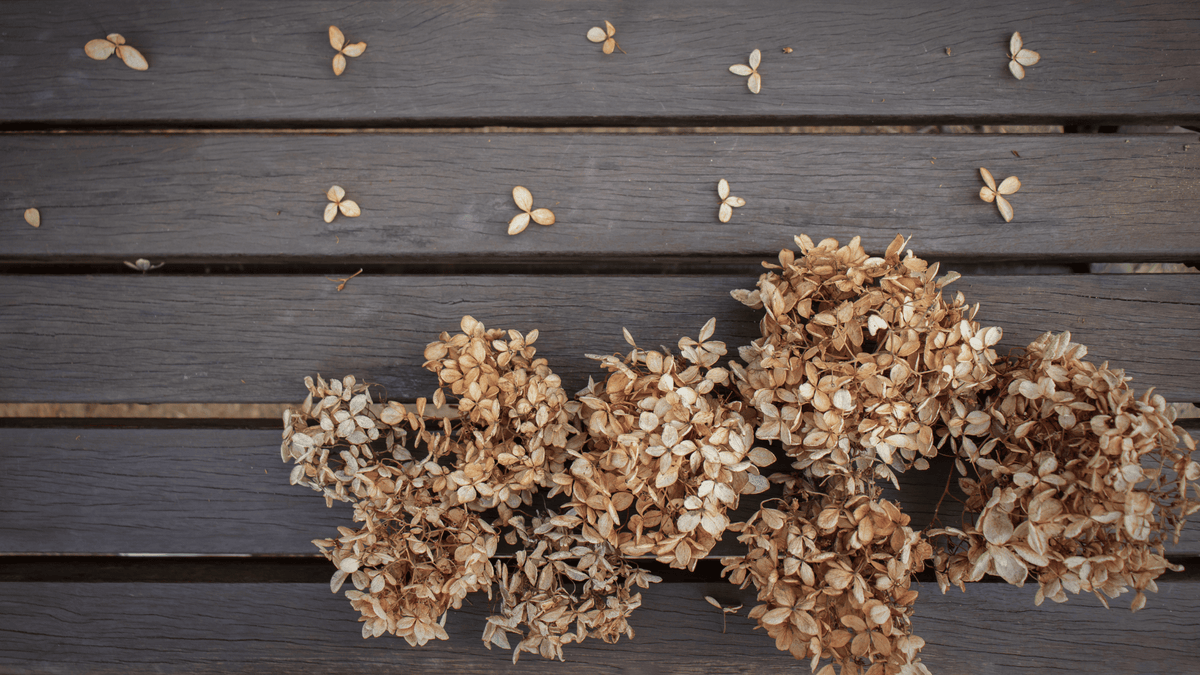
Hydrangeas are particularly useful flowers for bringing indoors because the same shrub can provide soft, fresh arrangements in summer and more muted dried flowers for autumn and winter. The important distinction is timing. A stem intended for a vase should be cut when the flower is fully developed and well hydrated, whereas a flower intended for ordinary air-drying is generally better left on the plant until the head has begun to mature and lose some of its softness.
Cut too early and a fresh hydrangea may wilt within hours; try to dry the same young, moisture-filled flower and it is liable to shrivel rather than retain its shape. The flower itself is therefore a better guide than a particular date. This is especially useful in Irish gardens, where the progress from fresh summer colour to mature autumn flower can vary considerably with position, exposure and the weather.
When to cut hydrangeas for fresh flower arrangements
For fresh arrangements, wait until the flower head is fully developed and has reached its mature colour. Very young mopheads, attractive though their mixtures of green and emerging blue or pink may be on the shrub, tend to be poor cut flowers because their tissues are still soft and they lose water quickly. A well-developed flower, with most of its florets open, is considerably more dependable.
Early morning is the best time to cut because the plant is normally well hydrated. Late afternoon or evening is a reasonable alternative, but avoid the warmest part of the day. Take a clean container of water into the garden and put each stem into it immediately after cutting rather than carrying a dry bundle around while more flowers are collected.
- Choose mature, fully developed flower heads rather than newly opened blooms.
- Cut the stem slightly longer than required so it can be trimmed again indoors.
- Remove the lower leaves, particularly anything that would sit below the water line.
- Re-cut the base cleanly at an angle before placing it in fresh water.
- Keep the flowers cool and out of strong direct sunlight while they rehydrate.
Hydrangea leaves are large and lose a considerable amount of water, so stripping most of them from a cut stem directs more of the available moisture towards the flower head. If foliage is wanted in the finished arrangement, separate leafy stems can be cut rather than leaving every leaf attached to the flowering stems.
Conditioning freshly cut hydrangeas
Hydrangeas usually perform better if they are allowed to rehydrate before they are arranged. Place the prepared stems in a deep container of clean water in a cool position for several hours. A commercial cut-flower preservative can be used if desired. If a flower head has already begun to wilt, immersing the head in water for a short period can sometimes help restore its firmness before it goes into the arrangement.
Once arranged, keep the vase away from strong sun, heaters and drying draughts. Check the water regularly, replace it when it becomes cloudy or stale, and re-cut the stem bases when changing the water. Shorter stems generally remain easier to hydrate than very long ones, which is worth remembering when a low arrangement would work just as well as a tall one.
When to cut hydrangeas for drying
Drying requires a different judgement. A freshly opened hydrangea is still carrying too much moisture to be a reliable air-drying subject. As the flower ages on the shrub its texture changes, the colours often become more subdued, and the head begins to feel firmer and increasingly papery rather than soft and pliant. This mature stage is usually the most dependable point for harvesting dried flowers.
With mopheads and related forms, another indication of maturity is the appearance of the small centres within the individual florets, which become more open and star-like as the head ages. Panicle hydrangeas may meanwhile move from cream or white through pink, rose or burgundy tones. Harvesting at different stages therefore produces dried flowers of noticeably different colour.
There are traditional drying methods in which flowers are taken somewhat earlier and allowed to mature while standing in shallow water, but very soft, newly opened heads remain more liable to collapse. For ordinary home drying, texture is the safer guide. Wait until the flower has begun its natural ageing process, then choose a dry spell and cut only after rain or morning moisture has disappeared from the head.
How to dry hydrangeas upright in a vase
The shallow-water method is simple and works particularly well when long stems are wanted for arrangements. Remove all the leaves, place the stems upright in a vase or bucket containing roughly 5cm of water, and leave them undisturbed. There is no need to replace the water as it disappears; the intention is for the flowers to dry gradually while the small amount of water helps them retain their form.
Do not crowd the flower heads tightly together. Air needs to move around them, otherwise adjoining blooms can dry into flattened or distorted shapes. A dark, dry place is preferable because sunlight fades colour and humid air slows the loss of moisture. Warmth can speed drying, but dryness and protection from light are more important than high temperature.
Once the water has evaporated, leave the stems until the flower heads and stalks are thoroughly dry before storing or arranging them.
Air-drying hydrangeas without water
Mature hydrangea flowers can also be dried without water. Long stems may be hung upside down individually or in small bunches, provided the heads do not press against one another. Short-stemmed flowers can be placed upright on open trays where air can circulate beneath and around them. Both methods work better with flowers that have already acquired the firmer, papery texture associated with maturity.
A dark, dry room, cupboard, loft or similarly protected space is preferable to a sunny windowsill. Damp conditions are the greater problem. If flowers are harvested during persistently wet weather or stored in a humid room, drying becomes slower and the quality of the finished flowers deteriorates.
Using silica gel when colour matters most
Silica gel is useful when retaining stronger, fresher colour is more important than keeping long natural stems. The flower head is placed in a container and carefully surrounded with the drying material so that the florets remain supported while moisture is removed. A sealed container allows the flower to dry much more rapidly than ordinary air-drying, while usually retaining colour more effectively.
This method suits smaller numbers of particularly good blooms rather than a large harvest from several shrubs. The stems normally need to be cut short to fit the container and can be extended later with florist wire or another dry stem if required. Microwave drying is better avoided; hydrangeas can be dried successfully without adding that additional risk.
Which hydrangeas are best for cutting and drying?
Mophead hydrangeas are among the easiest to use because their large, densely packed flower heads retain a strong shape when dried. Lacecaps can also be preserved, although their open structure produces a finer, more delicate effect. Panicle and smooth hydrangeas broaden the choice further, particularly if cream, green, pink and burgundy shades are wanted rather than the familiar blue and pink associated with many Hydrangea macrophylla cultivars. The main groups are compared in more detail in our guide to hydrangea flower types.
Hydrangea arborescens ‘Annabelle’ is especially useful where both fresh and dried flowers are wanted. Its rounded heads emerge green, become white as they mature and later return towards green, so the stage at which they are cut has a marked effect on the finished arrangement.
Among panicle hydrangeas, Hydrangea paniculata ‘Limelight’ provides substantial flower heads for indoor use. Panicle hydrangeas as a group are particularly good drying subjects because the flowers naturally acquire new tones as they age, allowing the gardener to choose between paler or more autumnal material simply by varying the harvest date.
Lacecaps need not be excluded. Hydrangea macrophylla ‘Blue Wave’ is a source-supported drying cultivar and gives a lighter effect than a dense mophead. For a more traditional rounded head, Hydrangea macrophylla ‘Bouquet Rose’ develops attractive aged colouring and can reach a useful drying stage comparatively early as its flowers move towards their autumn shades.
If flowers for the house are part of the reason for planting a hydrangea, it is worth choosing the shrub for this characteristic from the beginning rather than treating cutting as an afterthought. Mature size, position and flowering habit still matter, so the wider Hydrangeas collection should be considered alongside the practical guidance in our guide to growing hydrangeas in Ireland.
Cut flower stems without sacrificing unnecessary growth
When harvesting mophead and lacecap hydrangeas, resist the temptation to remove additional non-flowering shoots merely to obtain foliage. Those shoots are valuable parts of the shrub and, on types that flower from older wood, may contribute to the following season's display. Take what is needed from flowering stems and make a clean cut just above a healthy node.
This matters particularly when flowers for drying are collected late in the season. A long stem may be desirable for an arrangement, but there is little advantage in cutting substantially farther down the shrub than the finished display requires. Panicle and smooth hydrangeas flower differently, so their pruning requirements are not identical to those of mopheads and lacecaps.
Common reasons dried hydrangeas fail
- Cutting while the flower is too young: soft, freshly opened heads contain too much moisture and are more likely to shrivel or wilt.
- Harvesting wet flowers: wait until rain and surface moisture have dried before cutting.
- Leaving foliage on the stems: leaves slow drying and take moisture from fresh cut flowers.
- Crowding the heads together: compressed flowers dry into distorted shapes and receive poorer air circulation.
- Drying in strong light: sunlight accelerates fading, particularly when preserving blues, pinks and purples.
- Using a humid room: a dry atmosphere is more important than excessive warmth.
The most reliable results come from allowing the plant to do part of the work first. Once a hydrangea flower has matured sufficiently on the shrub, preserving it becomes comparatively simple; the gardener is no longer trying to force a soft summer flower to behave like a naturally dried autumn one.


