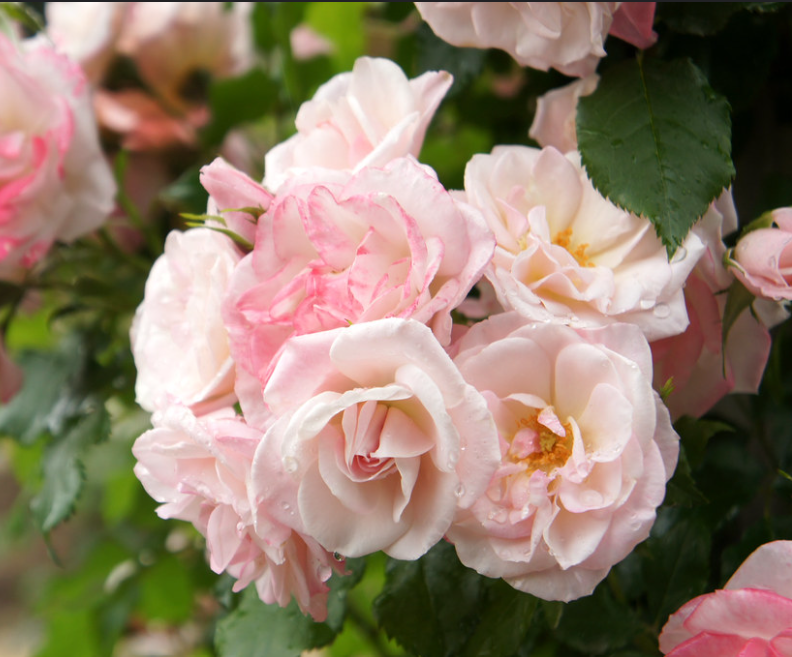
Choosing and Growing Climbing Roses in Ireland
Choosing a Climbing Rose
Climbing roses produce long stems that can be trained over walls, fences, arches, pillars and pergolas. They bring flowers into the vertical part of the garden and can soften large areas of masonry or timber, but they are not self-clinging. Every plant needs a strong support and regular tying-in as it develops.
The range includes cultivars such as Rosa ‘Dublin Bay’, ‘Compassion’, ‘Climbing Iceberg’, ‘Golden Showers’, ‘Zéphirine Drouhin’, ‘Jasmina’, ‘Kiss Me Kate’, ‘Scent from Heaven’ and ‘Golden Gate’. Select by expected size, flowering habit, scent and the amount of training space available.
Climbing Roses and Rambling Roses
Climbing roses usually develop a permanent framework of relatively sturdy canes with flowering side shoots. Many repeat flower and are suitable for walls, arches and supports where growth needs to remain organised. Individual cultivars differ, and some may give a stronger first flush than later displays.
Rambling roses are often more vigorous, with longer and more flexible stems and many smaller flowers carried in clusters. They are particularly useful for large pergolas, mature trees and extensive boundaries. Choose a climber for a defined vertical area and a rambler where broader coverage and greater natural spread are wanted.
Do not expect either group to attach itself to a wall. Fix horizontal wires, trellis or another support before planting, leaving enough space between the framework and the surface for air circulation and tying. Use soft ties that can be loosened as stems thicken.
Training Roses on Walls, Fences and Arches
Training has a major influence on flowering. If every stem is allowed to grow straight upwards, flowers may become concentrated near the top. Spreading the main canes diagonally or as close to horizontal as the support allows encourages flowering side shoots along more of their length.
On a wall or fence, create a fan-shaped framework and add new strong stems as the plant grows. On an arch, guide shoots around and across the structure rather than tying them only to the nearest upright. Check ties each season and replace any that are cutting into the stems.
Choose a support large enough for the mature rose. A small decorative trellis may hold a young plant but become inadequate after several years. The final framework should remain secure under the combined weight of wet foliage, flowers and wind movement.
Position and Planting
Most climbing roses flower best in a bright position with several hours of direct sun. Good airflow helps foliage dry after rain, but exposed sites can damage long shoots before they are tied in. A sheltered wall can be useful, provided the root area does not become excessively dry.
Plant away from the immediate base of a wall or fence where foundations, overhanging roofs and compacted soil create a rain shadow. Angle the stems towards the support and prepare a generous area of fertile, moisture-retentive but well-drained soil. Incorporate well-rotted organic matter through the wider planting zone.
Water deeply after planting and during dry periods while roots establish. Roses grown beside walls, hedges or mature shrubs may need additional watering because of reduced rainfall and root competition. Mulch the soil to conserve moisture, keeping the material clear of the stems.
Flowering, Deadheading and Feeding
Many climbing roses can flower repeatedly when faded blooms are removed, although the amount of later bloom varies. Deadhead within reach and allow inaccessible flowers to finish naturally. Some fertile varieties may form hips if flowers remain, but fruiting depends on cultivar, pollination and conditions.
Feed in spring as active growth begins and again according to the instructions for the chosen rose fertiliser. Tie in new stems promptly so they are not damaged by wind. Remove fallen diseased foliage from around the base and keep neighbouring plants from smothering the lower growth.
Pruning Climbing Roses
Build a permanent framework rather than cutting the entire plant hard back each year. Remove dead, damaged, diseased or badly positioned canes, retain useful main stems and shorten the side shoots that carried flowers. Older unproductive stems can be replaced gradually with strong new growth from lower on the plant.
Pruning timing and severity depend on the cultivar and flowering habit, so avoid treating every climber identically. Where a plant has outgrown its structure, renewal over more than one season is often safer than removing most of the framework at once. Explore our complete rose collection to compare climbing roses with ramblers and bush forms.