Choosing and Growing Viburnums in Ireland
Choosing the Right Viburnum
Viburnums are among the most versatile garden shrubs, offering flowers, fragrance, berries, foliage and seasonal colour across much of the year. This collection brings together evergreen, deciduous, winter-flowering, fragrant, snowball and doublefile varieties suited to a wide range of Irish gardens.
Choose a Viburnum according to its mature size, foliage type, growth habit and principal season of interest. The collection ranges from relatively compact shrubs for smaller borders to substantial specimens requiring several metres of space. Check the expected height and spread on each product page before planting.
Browse our specialist collections of evergreen Viburnums, deciduous Viburnums, fragrant Viburnums, winter-flowering Viburnums, snowball Viburnums and doublefile Viburnums.
Evergreen and Deciduous Viburnums
Evergreen varieties such as Viburnum tinus, Viburnum davidii and Viburnum rhytidophyllum provide useful foliage and structure throughout winter. They work well in mixed borders, informal screening and areas where year-round greenery is important.
Some Viburnums described as evergreen are more accurately semi-evergreen and may shed part of their foliage during a particularly cold, wet or exposed winter. This is not necessarily a sign of poor health, and plants will normally produce fresh growth when conditions improve in spring.
Deciduous Viburnums offer greater seasonal change. Depending on the variety, they may produce scented winter or spring flowers, ornamental berries and attractive autumn foliage before losing their leaves. Viburnum opulus, Viburnum plicatum and Viburnum carlesii ‘Aurora’ are especially useful in mixed shrub borders and naturalistic planting.
Flowers, Fragrance and Berries
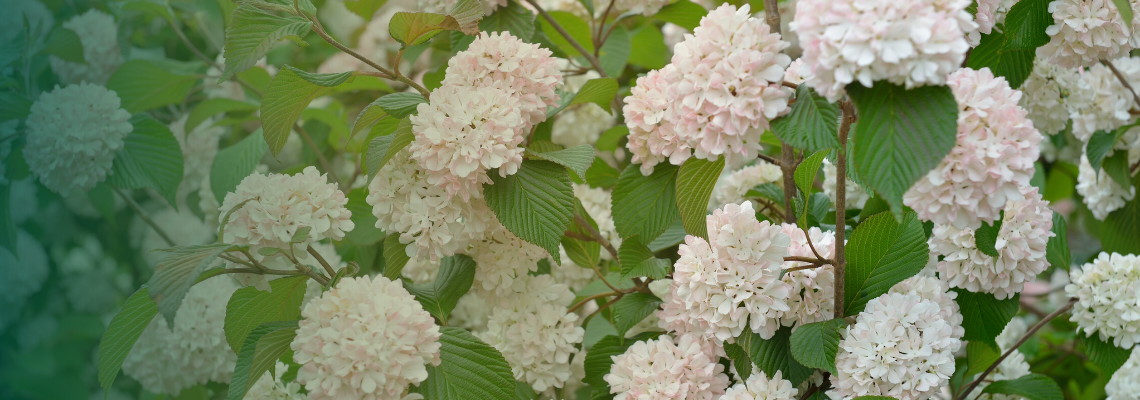
Viburnum flowers vary widely in shape and flowering season. Snowball varieties such as Viburnum opulus ‘Roseum’ carry large rounded flower clusters, while doublefile cultivars produce flat lacecap blooms arranged along distinctive horizontal branches.
Fragrant varieties are particularly effective beside entrances, paths, patios and windows where their scent can be appreciated. Viburnum × bodnantense ‘Dawn’ provides scented flowers during winter, while Viburnum × burkwoodii and Viburnum carlesii ‘Aurora’ produce strongly fragrant spring displays.
Many fertile Viburnums can develop ornamental berries after flowering where pollination conditions are suitable. Fruit colour varies by variety and may provide useful late-season interest as well as food for garden birds. Sterile snowball cultivars are grown for their flowers and will not normally produce berries.
Where to Plant Viburnums
Viburnums can be used as specimen shrubs, informal screens, flowering hedges or structural plants within mixed borders. Larger varieties are useful at the back of broad planting areas, while compact cultivars can suit smaller gardens and restricted spaces.
Evergreen Viburnums provide a dependable backdrop for perennials and deciduous shrubs. Fragrant types are best positioned near frequently used parts of the garden, while doublefile Viburnums need enough open space for their layered branching to be seen clearly.
Most Viburnums perform well in full sun or partial shade. A sunnier position can support stronger flowering, fruiting and autumn colour, while partial shade may be preferable where the soil remains cool and evenly moist. More tender or large-leaved evergreen varieties benefit from shelter from cold, drying winds.
Planting and Caring for Viburnums
Plant Viburnums in reasonably fertile, moisture-retentive but well-drained soil. Good drainage is particularly important during wet Irish winters. Improve the planting area with well-rotted organic matter, water young shrubs during prolonged dry weather and apply a spring mulch to help conserve soil moisture.
Pruning is generally limited to removing dead, damaged, crossing or awkwardly positioned growth. Where shaping is required, prune after flowering so the following display is not unnecessarily reduced. Avoid repeated hard trimming unless the variety is naturally suitable for hedging, as this can spoil its flowering and mature form.
Explore the full range below to compare Viburnums by mature size, foliage type, flowering season, fragrance and garden use.


 Sold out


 Sold out


 Sold out


 Sold out


