Choosing and Growing Doublefile Viburnums in Ireland
Choosing a Doublefile Viburnum
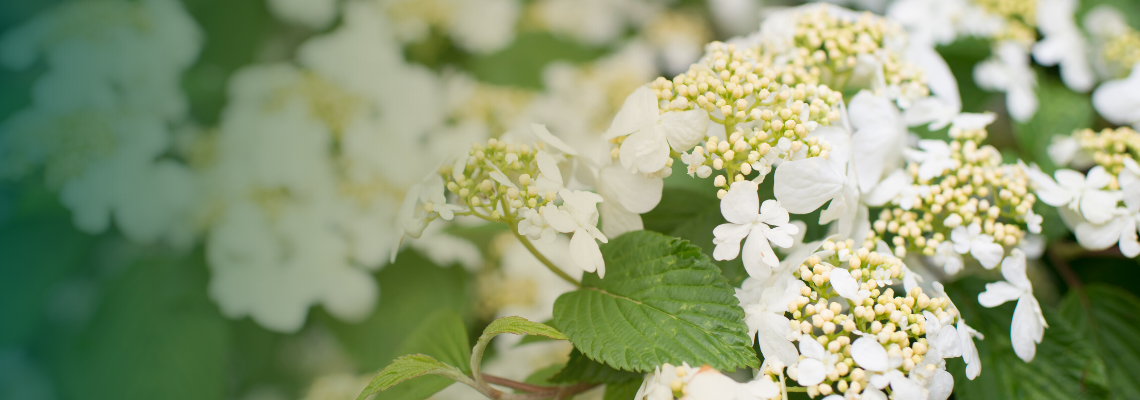
Doublefile Viburnums are admired for their beautifully layered branches and flat white lacecap flower heads. The flowers are arranged in rows along the horizontal stems, creating a refined, architectural display that looks especially effective in mixed borders, woodland-style gardens and Japanese-inspired planting.
This collection consists mainly of Viburnum plicatum f. tomentosum cultivars, including Viburnum plicatum f. tomentosum ‘Mariesii’, ‘Great Star’, ‘Kilimanjaro’, ‘Kilimanjaro Sunrise’, ‘Saint Keverne’, ‘Summer Snowflake’, ‘Watanabe’ and ‘Nanum Semperflorens’.
Although these shrubs share the characteristic doublefile flower arrangement, their eventual size, shape and flowering period can differ considerably. Check the mature height and spread of each cultivar before planting, particularly where space is limited.
Growth Habits and Mature Size
Traditional doublefile Viburnums develop a broad, spreading habit with strongly tiered branches. Their distinctive structure becomes increasingly impressive as the plants mature, but it requires enough space to be appreciated properly.
Viburnum plicatum f. tomentosum ‘Mariesii’ is well known for its wide, horizontal branching, while ‘Great Star’ also develops a substantial layered form. More upright cultivars such as ‘Kilimanjaro’ and ‘Kilimanjaro Sunrise’ can be easier to accommodate where border width is restricted.
Compact selections such as ‘Watanabe’ and ‘Nanum Semperflorens’ are better suited to smaller gardens, although their final size will still depend on soil, light and growing conditions. Avoid crowding wider varieties between vigorous neighbouring shrubs, as this can conceal their flowers and distort their natural shape.
Flowers, Fruit and Autumn Colour
The white lacecap flowers are usually held against fresh green foliage, producing a striking horizontal pattern across the shrub. The outer sterile florets create the showy display, while the smaller central flowers may attract visiting insects.
Flowering is generally strongest during spring or early summer, although cultivars such as ‘Summer Snowflake’ and ‘Watanabe’ may continue flowering intermittently over a longer period. Timing can vary according to the cultivar, weather and position.
Where flowers are fertile and pollination is successful, ornamental fruit may follow later in the season. The foliage of many doublefile Viburnums can also develop attractive red, purple or bronze shades during autumn before falling.
Where to Plant Doublefile Viburnums
Doublefile Viburnums are particularly effective as individual feature shrubs, where their distinctive branching can be viewed from several directions. They also work well toward the back of a mixed border or within woodland-inspired planting.
Their layered form combines naturally with ferns, shade-tolerant perennials, Japanese maples, astilbes and finer-leaved shrubs. Give broad-growing cultivars a clear space around them rather than planting them tightly against walls, paths or neighbouring shrubs.
Doublefile forms belong within the wider group of deciduous Viburnums. For varieties with rounded flower heads rather than flat lacecap displays, explore our snowball Viburnums.
Planting and Caring for Doublefile Viburnums
Choose a position in full sun or partial shade with fertile, moisture-retentive but well-drained soil. Good light can support strong flowering and autumn colour, while partial shade is suitable where the ground remains evenly moist.
Avoid soil that remains waterlogged during wet Irish winters. Incorporate well-rotted organic matter before planting, water regularly while the shrub establishes and apply a spring mulch to conserve moisture without covering the base of the stems.
Pruning should be kept to a minimum. Remove dead, damaged, crossing or badly positioned branches after flowering. Avoid cutting the entire shrub into a formal shape, as regular trimming can spoil the horizontal, layered habit for which doublefile Viburnums are valued.
Browse our complete Viburnum collection to compare doublefile varieties with fragrant, evergreen, winter-flowering and snowball-flowered selections.


 Sold out


